prijava
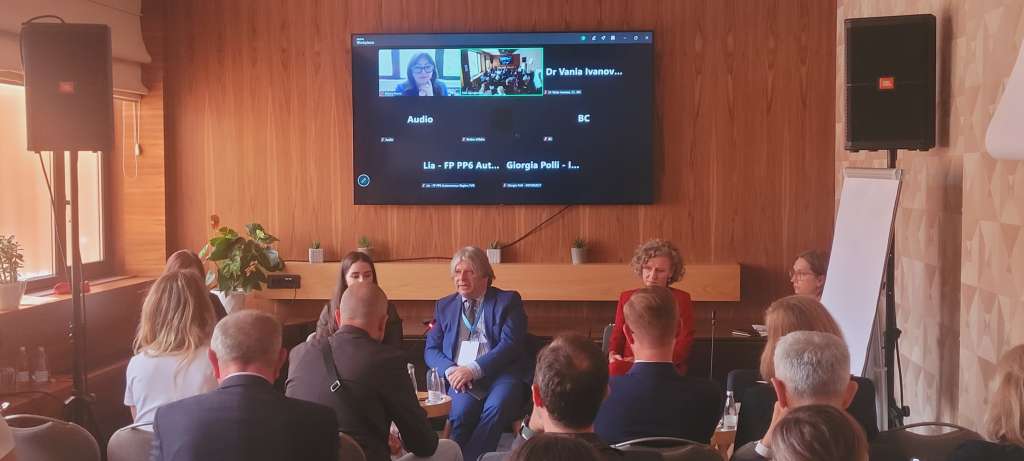
SKOPJE, May 20 (FENA) – The European Union Strategy for the Adriatic and Ionian Region (EUSAIR) has become an important instrument supporting the EU enlargement process through concrete projects, institutional cooperation, and strengthening the administrative capacities of candidate countries, it was said at the panel ''EUSAIR as a Driver of EU Enlargement: From Cooperation to Concrete Results,” held within the 11th EUSAIR Forum in Skopje.
The panel concluded that EU enlargement is no longer a separate political process conducted exclusively through negotiations in Brussels, but is increasingly taking place through concrete regional initiatives, infrastructure projects, energy transition, and alignment of regional countries’ policies with EU standards.
The panel moderator noted that EUSAIR brings together EU member states and candidate countries, with candidate countries currently outnumbering EU member states within the Strategy itself.
For this reason, enlargement is not a separate objective but an integral part of EUSAIR’s work. It was emphasized during the introduction that the aim is to show why it is important to be part of the Strategy, as well as how to further strengthen the support it can provide to the EU integration process.
Zuica Zmejkovska from the Ministry for European Affairs of North Macedonia assessed that EU enlargement is currently high on the political agenda of all countries participating in the Strategy, but that political messages now need to be translated into practice.
She said that while political statements and promises can be made, those working on implementing the Strategy want to see concrete application of these messages on the ground.
Zmejkovska stressed that the enlargement process does not take place only through formal negotiations and meetings of senior officials in Brussels, but through everyday cooperation between institutions, experts, and administrations in the region.
She recalled that in the revised EUSAIR Action Plan, enlargement has for the first time been defined as a horizontal theme of the Strategy.
According to her, one of the previous challenges was the lack of visibility of concrete results of macro-regional cooperation.
She said many are not aware that a significant part of the EU approximation process is already taking place through EUSAIR, and that concrete processes are happening on the ground but are often not sufficiently recognized.
She assessed that the Strategy is now entering a new phase in which support for enlargement will be more organized, structured, and concrete.
A special focus of the panel was energy and the green transition, as one of the key challenges for both EU member states and candidate countries.
Biljana Ramić from the Ministry of Mining and Energy of Serbia, who addressed participants online, said EUSAIR offers candidate countries an opportunity to understand European policies and processes through practical cooperation.
She said EUSAIR is a very specific mechanism with clearly defined rules, governance structures, and processes, providing a good opportunity to better understand EU policies and procedures.
She stressed the importance of cooperation in the energy sector and the energy transition process.
According to her, one of the most important results of EUSAIR work in the energy field is the development of an energy network master plan, as well as the identification of strategic projects and measures within the Strategy.
She also highlighted the revision process of the EUSAIR Action Plan, which she said was demanding but extremely important for the countries of the region.
The panel also emphasized that transport connectivity remains one of the key elements of European integration and regional cooperation.
Jasminka Kirkova from the Ministry of Transport and Communications of North Macedonia stressed that connectivity between Adriatic-Ionian countries is not only an infrastructure issue, but also a matter of deeper regional integration with the European Union.
She said transport connectivity means coordination of policies and joint investment planning between EU member states and candidate countries.
She recalled that two important Pan-European corridors—8 and 10—pass through North Macedonia, now forming part of the Western Balkans–Eastern Mediterranean corridor.
She said the master plan developed through the Strategy shows the current situation and provides projections for development over the next 10 to 20 years.
According to her, the document enables the identification of priority investments and key infrastructure points that need upgrading.
She stressed the importance of improving border crossings to enable easier and faster movement of people and goods.
Speaking about alignment with EU transport standards, she highlighted the importance of interoperability of digital systems between regional countries and EU member states.
She added that this is crucial for transport digitalization and more efficient cross-border movement of goods.
Panel participants concluded that EUSAIR represents a unique framework in which EU member states and candidate countries can cooperate on an equal basis through concrete projects and joint policies.
It was emphasized that the Strategy enables regional countries to prepare for EU membership through practical work, particularly in the areas of energy, transport, digitalization, environmental protection, and regional connectivity.
It was also noted that EUSAIR contributes to strengthening institutional capacities of candidate countries, exchanging experiences, and aligning with European standards well before formal EU membership.
(FENA) A. B.